
Satellite Spectrum – perhaps it is time to use the right tool
Hello,
I have been following the continued discussions about obtaining increasingly detailed spectrum information from DVB tuner cards and satellite receivers.
I find this slightly ironic.
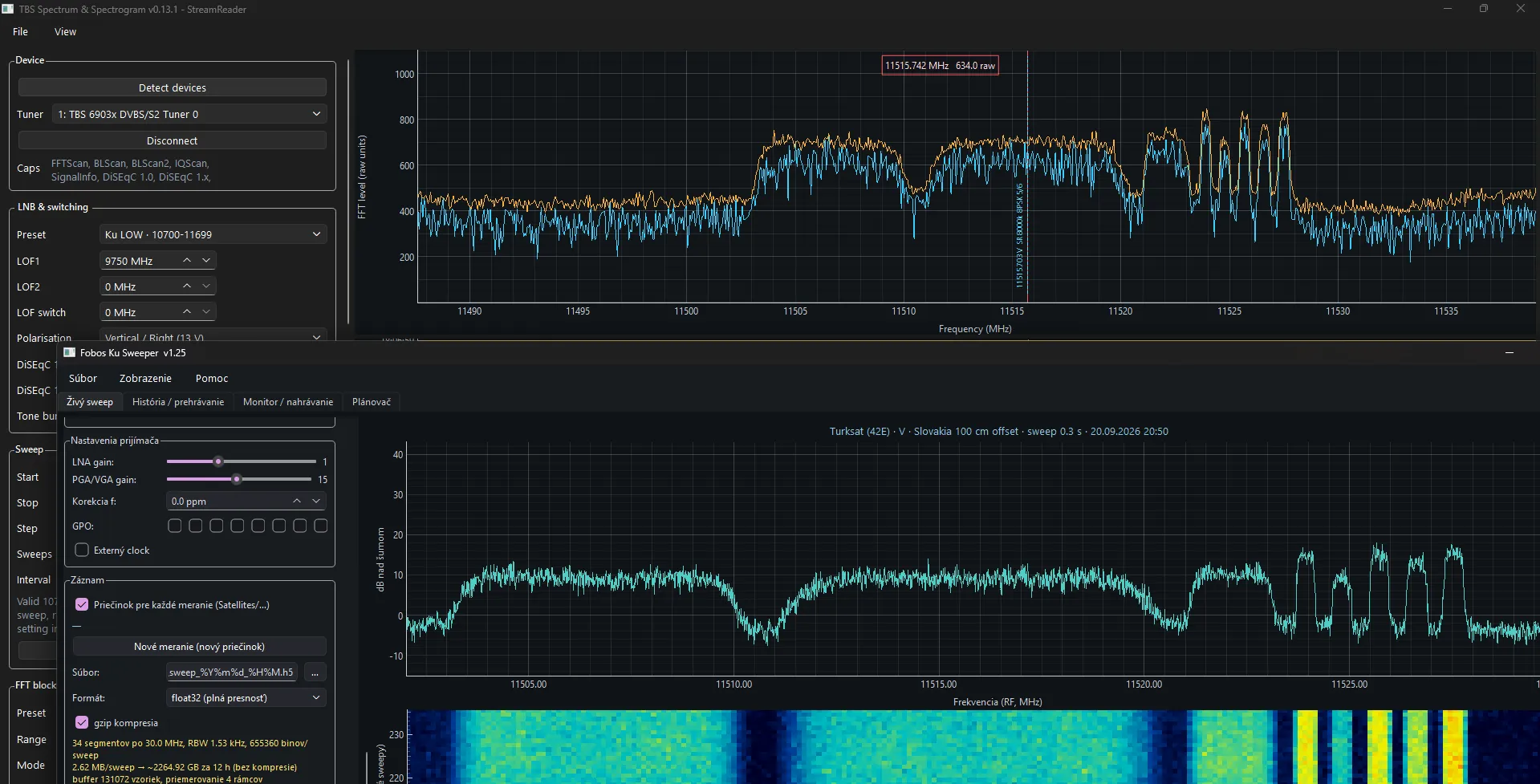
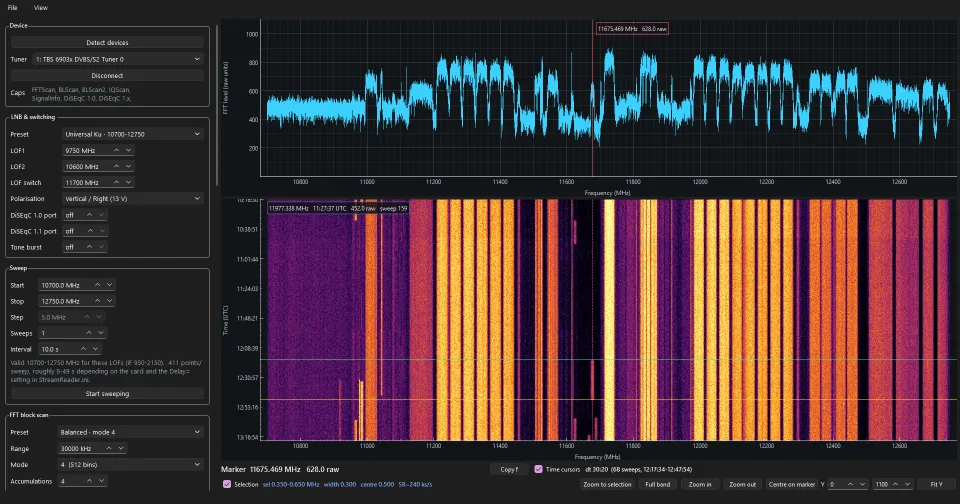
Satellite enthusiasts are prepared to spend considerable amounts of money on dishes, feeds, LNBs, positioners, tuner cards and receivers, and then spend an enormous amount of time trying to overcome the limitations of a DVB tuner in order to obtain something approaching a proper spectrum display.
A DVB tuner is fundamentally a receiver and demodulator. Its spectrum display can be extremely useful for finding transponders, checking reception, blindscan and identifying signals. I have worked with these techniques myself for many years, and it is remarkable how much useful information can be extracted from comparatively inexpensive tuner hardware.
But there are physical and architectural limits to what such hardware can provide.
If the objective is really to examine the RF spectrum - weak carriers, adjacent signals, transponder shape, interference, noise floor, bandwidth, shoulders, spurious signals, etc. - why not use an instrument designed for that purpose?
A proper spectrum analyser is the obvious solution, and used instruments are often surprisingly affordable. Today there is also another very accessible option: an SDR.
Devices such as a HackRF, PlutoSDR or similar wideband SDR can provide a much more detailed and flexible view of the spectrum than the relatively low-resolution sweeps produced by most DVB tuners.
This does not make tuner-based spectrum displays useless. Quite the opposite. They are excellent tools when the objective is receiving and analysing DVB signals.
But spectrum analysis and DVB reception are two different jobs.
For DVB parameters, lock, modulation, FEC, MER, constellation, transport streams, blindscan, etc., use the tuner.
For examining the actual RF spectrum, use a spectrum analyser or an SDR. It will show you ALL transponders, no matter how low the SR. You will be able to determine the frequency and can THEN try to lock the transponder with a specific blindscan on that frequency.
There comes a point where spending more and more effort trying to make a DVB tuner behave like RF measurement equipment becomes less practical than simply adding the appropriate instrument to the setup.
For serious satellite experimentation, I think the ideal solution is to have both. They complement each other extremely well.
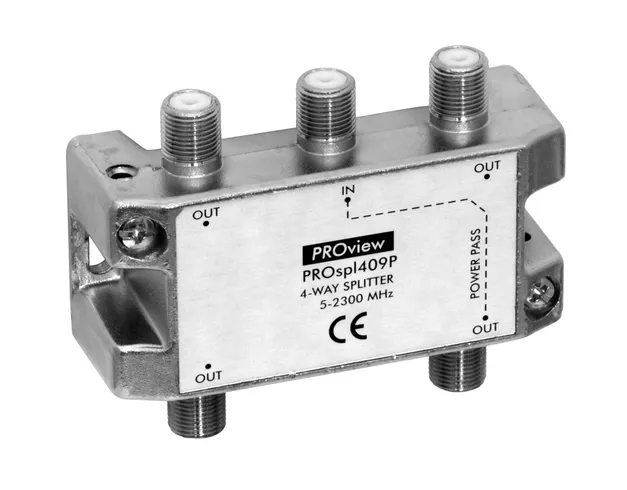
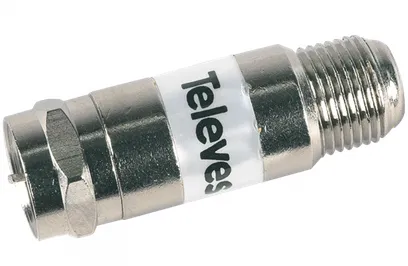
Just make sure to use a DC BLOCKER when connecting the LNB output of the receiver (or a T), to prevent burning the input stage of the spectrum analyzer/SDR.