Posts by Fey

    Hello Friends, :36:
    it's finally time for a new skyscraper8 update.

    This time I brought along these changes:
    - (S8) I dipped my toes into ISDB-T. skyscraper8 contains a preliminary parser for *some* parts of ISDB. For example, at this point in time ISDB Caption Management can be decoded, which means we can get a transcript of the live subtitles. (Thanks to frankviana for the samples!)
    - (S8&V) Fixed a bug that would cause a crash when zapping to the NIP mux on 7°E. They used a DVB-I Service list here which doesn't have a name, and that confused skyscraper8. (Thanks to PantaSat for the sample!)
    - (S8&V) Fixed a bug that would cause a crash when zapping to a NIP mux and a corrupted LCT Frame was received.
    - (S8&V) Can now capture audio found in RTP streams like in the Simmin mux, and store it in .mpa Format.
    - (S8) skyscraper8 now *partially* understands FAT (Fast Access Table), SAT (Satellite Access Tables), and TDT (Time date Tables) in RCS2 muxes. This fix was necessary to get the Simmin mux working again.
    - (S8&V) The MAX SX8 variant of the Digital Devices Octopus NET has a pretty cool party trick up it's sleeve: It can force-encapsulate any zapped stream into a BBFRAME-pseudo-TS. (deeptho's neumo-drivers can do this as well, when the user-space application sets DTV_OUTPUT_BBFRAMES) This is useful for example if you want to record all streams in any of the italian Transponders on 5°W with only one tuner. skyscraper8 now understands such Recordings.
    - (S8&V) When capturing Network traffic into PCAP, or an embedded TS, the files no longer get locked exclusively. This means that we now can open them in Wireshark/VLC while they're being written.

    Showcase Video here:

    External Content youtu.be
    Content embedded from external sources will not be displayed without your consent.
    Through the activation of external content, you agree that personal data may be transferred to third party platforms. We have provided more information on this in our privacy policy.
    (I've been diddling around with the Video recording Settings again. I hope it's ledigble better now. Recording Video is still a new thing for me.)

    Update file here: https://mega.nz/file/EhN3XKaD#…CHj5ZNxibVheuwE

    On other related note: This time it's not my health at fault why it took me so long, but my poor time management skill. I'm a bit sad that I didn't manage to pour more time into this Project. :37: I certainly don't want it to die, so I'll try to get better. - and I'm still trying to find an installation handiman for the future second dish. But that's tougher than I expected in my area!

    Thanks for reading, have a nice day, and happy DXing!

    Fey:3:

    Hi friends!

    It's been a while (real-life, work, and stuff), but today I have a new program to show. I've been playing around with my Digital Devices Octopus NET, and found that it does have some nice party tricks up its sleeve.

    For example, it can be made to give values like SNR and Signal strength by sending a specific HTTP request to it.

    Once I had that figured out, I wanted to do something fun with this knowledge. One of my other hobbies is homelabbing - so why not bring both together?

    Those of us who have dipped their toes in homelabbing, smart-home, or enterprise-grade IT might have already heard of Prometheus and Grafana. These are two open-source tools that are commonly used together to monitor and visualize metrics from various sources. Prometheus is a time-series database that collects and stores metrics from different sources, while Grafana is a visualization tool that allows users to create dashboards and visualizations based on the data collected by Prometheus.

    And now using my octonet-exporter program, we can make Prometheus collect metrics from an Octopus NET device and visualize them in Grafana.

    For those of us who run Prometheus and Grafana, this gives us a convenient way to long-term monitor and visualize reception quality of frequencies an Octopus NET is tuned to.

    As this program is designed to run in the background and will, due to its nature, take a fair bit of time to show what it can do, I don't have a showcase video this time.

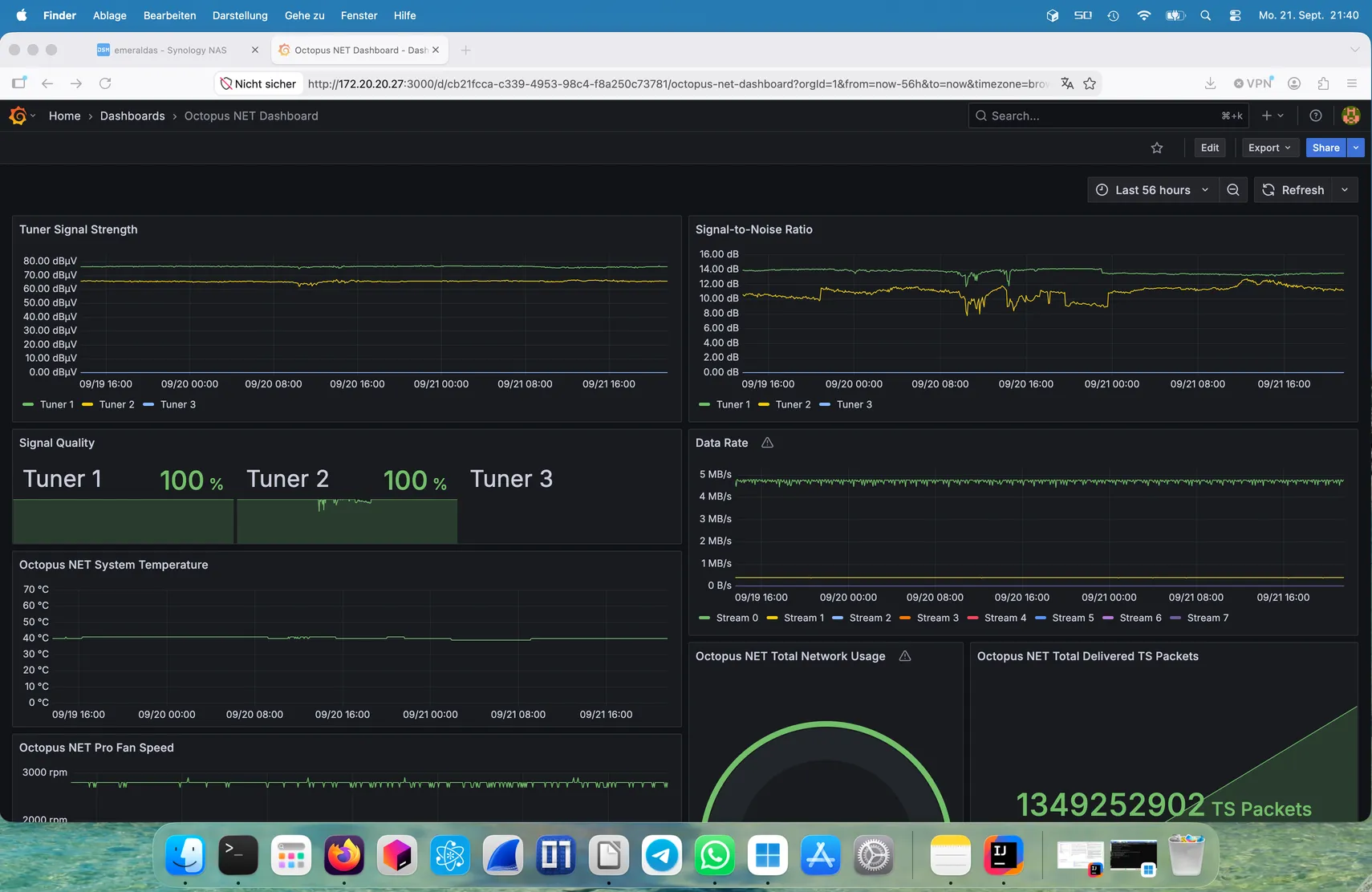
    But I do have a screenshot of a Grafana dashboard that shows an example of metrics collected by the octonet-exporter program:

    In this example screenshot, I had my Octopus NET's Tuner 1 on 19,2°E/12460/H (green line) and Tuner 2 on 19,2°E/11604/V (yellow line). One can clearly see that the weather at my home wasn't very good on the 20.9. around 09:00-12:00. 😁

    This program is more a proof-of-concept than a finished project, so there's something I'd like to ask you:

    • Is there a demand for a tool like this? I do realize that not many do own an Octopus NET device. But would a tool like this for TBS cards be interesing? StreamReader.dll's API provides methods to developers to read things SNR/BER, among some other things. That would make writing an exporter easy. So I wonder whether a streamreader-exporter (or tbs-exporter? 🤔) would be useful.
    • How interesting are long-term monitoring tools like these in general to the community?
    • Of course I also understand that not many users do run Prometheus/Grafana, given that these are rather niche tools. If my octonet-exporter (or other future exporters) seem interesting enough, would you be interested in a detailed guide in setting Prometheus, Grafana and *-exporter up?

    Long story short, here's the download link to octonet-exporter, including both a compiled binary and the source code: https://mega.nz/file/I1sF1Bib#…vWOLnrk9t8GIYnM

    octonet-exporter is written in Java and has been tested fine on Windows 11, Devuan GNU/Linux 6 and macOS Tahoe.

    AI disclousure: I do use an LLM-based line-autocompletion tool, but the program logic, I came up with by myself.


    Thanks for reading and happy DXing!

    Cheers,

    Fey
    :3:

    Hi all!

    Just a short sign of life from me: I've been experimenting with the 34.5°W sample during the last few days. I figured out why the inner stream gets corrupted during extraction: While it is indeed (mostly!) valid GSE - there is some spice added to it: For some reason the "GSE Length" in some GSE Packets is set to a wrong value. (by the broadcaster, not by the client software) Since the parsing of the BBFRAME containing that Packet fails because of this, skyscraper8 silently drops the BBFRAME which of course might result in some packets in the inner stream missing.

    I'm still trying to find a pattern to this, but at this time I'm kinda stuck.:25:

    Thanks for the patience of those who generously donated samples here in this thread and via DM. I couldn't have gotten this far without your help.:31:

    Some minor other skyscraper8 related news:

    • I got a permit from my landlord to have a second dish installed on the roof in the house my room is in. Right now I'm debating with my roommate of whether to get a WaveFrontier T85, or a smaller motorized dish - and of course who to turn to to have it installed. Either way, this would make me way more flexible and way less dependant on driving over to my hut. (and getting days off from my dayjob! 😅)
    • The laptop I did my coding on kind of died so I got myself a MacBook Air. While macOS does not have a DVB-Stack (like Windows has BDA, or Linux has v4l2) at all, I find it to be a very competent machine to do coding on. Thankfully, the "Windows App" exists, so I don't have to forgo StreamReader or the tuners. Although trying to control a 5580 or 5927 using libusb might be a fun project as well, perhaps I might look into that.

    Thanks for reading and cheers!

    Fey:3:

    Hi!

    Thanks for sharing this interesting sample. 😋
    I won't be able to get to my hut this month, and even there, my reception of 70.5°E is very weak (possibly due to very shaky trees in the way). I barely get the MTA 7 channel on there. 😅

    If it's not too much trouble, could you please check what StreamReader.dll version the application you recorded this sample with was using? If it was below 1.2.5.208, please try recording a sample again with StreamReader.dll version 1.2.5.208 - available on crazycat's Sourceforge. ( https://sourceforge.net/projects/crazy…DA.rar/download ) Does the recording look different? (PID)

    I've seen some older StreamReader.dll versions sometimes do strange things with GS/GSE encapsulation, that's why I'm curious.

    Thanks and regards,

    Fey. :3:

    Vielen Dank euch allen! 🥰

    Ich freue mich auch in meinem neuen Lebensjahr auf ein paar schöne technische Herausforderungen, und hoffentlich auch auf was, was ich teilen kann. :)

    -

    Thanks to all of you! 🥰

    In this new year of my life I'm looking forward to more new cool technical challenges, and hopefully also some that result in something shareable. :)

    Hi friends!:3:

    Today I'd like to present you a small side project of mine.

    This is pcap2mpe, a tool that uses WinPcap on Windows or libpcap on Linux to capture network packets on one user-specified interface and transparently generate a TS from it.

    To launch it, just call the pcap2mpe.exe on the commandline and specify the Device Path for the network device as an argument. If no commandline argument is speicfied, it will list all network devices it can see. Once running, it will output TS packets onto 127.0.0.2:6969.

    Showcase video:

    External Content www.youtube.com
    Content embedded from external sources will not be displayed without your consent.
    Through the activation of external content, you agree that personal data may be transferred to third party platforms. We have provided more information on this in our privacy policy.

    Download file: https://mega.nz/file/4lFFTCCR#…cFacpgE44QMcZTU - the download does include the source code to the tool and binaries for 64-bit Windows. On Linux, you'd need to install the .NET SDK (instructions on https://learn.microsoft.com/en-us/dotnet/core/install/linux ) and compile it by running "dotnet publish" in the shell. That generates a runnable pcap2mpe binary.

    Known limitations of this tool:

    • Right now this only generates MPE, not INT. Only PAT, PMT, TDT and MPE are generated.
    • Although it reserves PID 0x0098 for PCR in the PMT, the tool (at this point in time) does not generate packets for PCR.
    • This tool (at this point in time) makes no attempt to maintain the TS bitrate. Therefore it doesn't generate NULL packets (0x1fff)
    • A new PID is used (and added to the PMT) for each VLAN the network device can see.
    • As this tool captures and encapsulates ALL incoming/outgoing network packets, it is highly recommended to have a second network interface to send the generated TS somewhere.

    An example on how to overcome the bitrate and PCR shortcoming using TSDuck's tsp is provided in the archive, in the HOW_TO_USE.md file.

    Although this is a very niche use-case, I hope this is useful to someone. :74:

    Cheers,

    Fey:73:

    Hi all!:3:

    As promised earlier here's the new update to skyscraper8, and it's companion application, Voile.

    This update introduces the following changes:

    • Added support for ATSC 3.0 STLTP
    • Added basic support for ATSC 3.0 PLPs. However, this is not a complete ATSC 3.0 implementation. It's just enough to get the TVRO3.0 sample on 65,0°W/11304/V to extract. In reality, ATSC 3.0 has a far larger and more complex feature set.
    • Rewrote the processing of IP packets. Up until now, skyscraper8 treated every IP packet as if it came from the same source. However, this is not ideal when you have IP Packets wrapped in IP packets, like in ATSC 3.0 STLTP. Now, skyscraper8 shows where it found the packet.
    • Added support for INT Tables pointing towards multiple IP/MAC Stream Locations. Up until now, only one was supported and more would cause a crash. This is now fixed.
    • Added support for extracting the segments from the ThreeMedia OTT Stream on 117°W/4050/V
    • Up until now, encountering a packet with an invalid Sync byte (0x47) would cause skyscraper8 to stop processing the input stream with the message "Buffer is not a TS packet". Now it won't anymore. The invalid packet will simply be skipped. I've observed this behaviour on some versions of EBSPro, but I'm not quite sure yet why it happens.

    Showcase video here:

    External Content youtu.be
    Content embedded from external sources will not be displayed without your consent.
    Through the activation of external content, you agree that personal data may be transferred to third party platforms. We have provided more information on this in our privacy policy.
    (This time I tried recording the video at higher resolution and with higher bitrate. I hope the commands are now better legible.)

    Update file here: https://mega.nz/file/h192lAQI#…Zye3vP261tkMiYk

    What's on my roadmap right now:

    • Checking the streams on 34,5°W/12673/H, 61°W/12005/H, 45°W/11159/V, 45°W/12709/V
    • Diddle around more with StreamReader.dll in order to hopefully get an FFTScan working in Voile.
    • ATSC 1.0 (I got some samples for this already.)
    • ISDB S/C/T (These are hard to come by in Germany. If anyone has samples for this, especically japanese ones not in the TSDuck Sample repository, that would be a great help!)

    Cheers,
    Fey :150:

    O-M-G! Danke! Du hast mir gerade jede Menge Stress erspart! :78:
    Da ich meine 6903 gebraucht in Brasilien erworben habe und sie demnach weit gereist ist, hatte ich schon befürchtet, dass sie auf welche Art auch immer defekt war, aber es war tatsächlich der Treiber. Ich hatte mich innerlich schon damit abgefunden, nur einen Tuner nutzen zu können.

    Bei diesem Workaround gibt's aber ein kleines "aber:"
    Nach dem Einspielen des Treibers auf meinem AsRock J4125M lief die Karte sofort wie erwartet, mein Lenovo P520 war jedoch weniger begistert davon:

    Auch dies lies sich einfach lösen - einfach in Windows Defender die "Speicher-Integrität" deaktivieren, dann läuft's. Dabei sollte man sich jedoch bewusst sein, dass dies unter Umständen ein Einfallstor für Rootkits aufmacht. (Nicht den Treiber selbst, der ist okay, aber die abgeschaltete Speicher-Integrität)

    Viele Grüße,

    Fey.:73:

    -

    OMG! Thank you, you just saved me a lot of stress with this post!:78:
    Because I bought my 6903 used in Brazil and it had a Long journey to Germany, I assumed it had some Kind of defect, but yes, it was actually the Driver. In my head, I already arranged with just being able one tuner.

    Hoever, even though I'm happy this works, there's a small "gotcha" with this:
    After installing the Driver on my AsRock J4125M, the Card immediately began working as expected, but my Lenovo P520 began yelling at me: (see screenshot above)

    The fix for this is easy: Just disable "Memory Integrity" in Windows Defender, then the driver will work. Hoewever, please do be aware that some rootkits *might* misuse this as a floodgate. (not the driver itself, that one is okay, but the disabled Memory Integrity)

    Cheers,

    Fey:73:

    Hi Friends!

    TBS has stopped selling the 6903 quite some time ago, which is a pity, because, in my opinion, the STV091X is an amazing chipset.

    Now while I do like the 5927, I very much prefer my Computers to have as little periphials as possible (less things to pack when moving between my room and my hut.)

    So I was overjoyed when I got lucky and managed to buy a used 6903 from a Brazilian online flea market.:12:

    But unfortunately, the used card came without the SATA power adapter. I tested the Card and it works, but I "stole" the power cable from my 6903x. Now I'm happy that I got a working 6903, but it's rather unpleasant that my 6903x refuses to lock without it's power cable connected.

    Now I'm wondering what the best way to get such a power cable would be? The German TBS Reseller doesn't seem to sell these on their own. I guess it's probably easy to make one by oneself if one is skilled in electronics/soldering - but I'm not. Does anybody know a shop (ideally within the EU) which sells these specific cables, or has some other means of sourcing these?

    I was thinking of buying a 6902 just for this cable - but before dropping 119€ on it, I'm curious on whether there is a more efficient way.:80:

    Cheers,
    Fey:3:

    -

    Hallo zusammen,

    TBS verkauft seine 6903 ja schon eine ganze Weile nicht mehr, was ich schade finde, da der STV091X meiner Meinung nach ein fantastischer Chip ist. Nun gefällt mir die 5927 zwar sehr gut, ich ziehe es aber vor so wenig Peripherie wie möglich an meinen Computern dran zu haben. Ist weniger zu packen, wenn ich zwischen meiner Wohnung und meiner Hütte hin und her pendle.

    Als sich die Gelegenheit geboten hat, auf einem brasilianischen Online-Flohmarkt eine gebrauchte 6903 zu erstehen, habe ich direkt zugeschlagen.:12:

    Leider war das SATA-Stromkabel, was ja sonst TBS Karten beiliegt nicht dabei. Ich habe die Karte getestet und sie funktioniert einwandfrei, doch dazu habe ich das Stromkabel meiner 6903x benutzt. Nun freue ich mich zwar über eine funktionierende 6903, aber dass meine 6903x sich ohne Stromkabel weigert zu locken, ist eher unschön.

    Jetzt frage ich mich, wie ich am besten an ein solches Stromkabel komme? Der deutsche TBS Reseller hat diese nicht einzeln gelistet. Wahrscheinlich ist es, wenn man halbwegs in Elektronik/Löten versiert ist, einfach ein solches Kabel selber zu machen, das bin ich aber nicht. Kennt jemand einen Händler (idealerweise in der EU) welcher diese spezifischen Kabel verkauft, oder gibt es eine andere Möglichkeit an diese dran zu kommen?

    Mein erster Gedanke war es, einfach eine 6902 zu kaufen, nur um an das Kabel zu kommen, aber bevor ich 119€ dafür hinlege, stellt sich mir natürlich die Frage, ob es da nicht einen eleganteren Weg gibt.:80:

    Danke und Gruß,
    Fey:3:

    Hi all!

    Thanks for submitting this sample, will take a look at it ASAP.

    I've "been in the zone" (I think in psychology it's called "flow") for a bit because I've been cooking an ATSC 3.0 and TVRO 3.0 parser into skyscraper8.

    I'm really hyped about this right now :91:, after finally getting playable video out of the sample I got of 65W, so I want to give a showcase video early:

    External Content www.youtube.com
    Content embedded from external sources will not be displayed without your consent.
    Through the activation of external content, you agree that personal data may be transferred to third party platforms. We have provided more information on this in our privacy policy.

    The sample I had contains two channels. One is playable using the "cat" method known from DVB-NIP before. The other one not, because they use some pixel format which ffmpeg and VLC do not support yet.

    I'll release the update file soon. Right now I'm not quite satisfied with the path the packets wander through the code. An ATSC 3.0 mux may use multiple virtual IP networks under the hood. skyscraper8 wasn't really designed to deal with multiple networks at once, so right now I used kind of a dirty hack by muxing the packets from the virtual networks onto an unused PID. This works, but I really don't like it. Plus, I also want to display ATSC3.0 / TVRO3.0 metadata in Voile. Gotta make it nice before releasing it to the public.

    Cheers,:3:

    Fey

    Thank you so much for the recognition!

    Just like PantaSat I feel incredibly honored to get a reputation like this.:74:

    I admit, I hesitated a lot before registering here. I was afraid that people wouldn't take me serious since I don't have a good antenna, or for other reasons. I am incredibly happy that this is not the case. I know this fear was probably without reason, but well... Mental Health issues do wild things with one's head. The time I spent here so far has been incredibly valuable to my personal growth - and my therapist agrees.
    And I admit as well that I am surprised how well my piece of software is received, which I mainly started writing because I love technical challenges.

    Many thanks to all of you. :3:

    -

    Vielen herzlichen Dank für die Verleihung dieses Titels!

    Ähnlich wie PantaSat fühle ich mich unglaublich geehrt, eine solche Wertschätzung zu erfahren.:74:

    Ich muss gestehen: Ich habe lange gezögert, bevor ich mich hier registriert habe. Ich hatte die Befürchtung, dass man mich nicht ernst nehmen würde – sei es, weil ich über keine gute Antenne verfüge, oder aus was auch immer für anderen Gründen. Es macht mich sehr froh, dass dies nicht der Fall ist. Ich weiß zwar, dass diese Furcht vollkommen unbegründet war, aber leider können diverse Mental-Health Probleme sehr unlustige Effekte in meinem Kopf hervorrufen. Die Zeit die ich nun hier verbracht habe, hat sich als unheimlich wertvoll für mein persönliches Wachstum herausgestellt - da stimmen mir sowohl mein Therapeut als auch meine Freunde zu.

    Und ich gebe ebenfalls zu, dass ich überrascht bin, wie gut meine Software angenommen wird – ein Programm, mit dessen Entwicklung ich ursprünglich vor allem deshalb begonnen hatte, weil ich technische Spielereien und Herausforderungen liebe.

    Vielen Dank an euch alle! :3:

    Hi all!

    This time only a minor update.

    * (S8&V) Added support for AAL5 PDUs in MPE. (read further on why this is interesting. Thanks to the respected EnoSat and frankviana for the sample. :18:)
    * (S8&V) Fixed a crash that would occur the PUSI flag in a TS packet with an MPEG-2 section was set, and the starting pointer was out of bounds. (Thanks to apsattv who found this crash with the sample of 122.1E that caused this. :18:)
    * (S8) Added a "salvage" command-line Option which will try to repair a broken TS file. There is, of course, no guarantee that this will produce a playable TS file, but it can filter out packets on which the sync byte is wrong, or force-patch it. No corresponding button in Voile yet, but this is on the agenda.

    Showcase Video here:

    External Content youtu.be
    Content embedded from external sources will not be displayed without your consent.
    Through the activation of external content, you agree that personal data may be transferred to third party platforms. We have provided more information on this in our privacy policy.

    Update file here: https://mega.nz/file/A5tyxQKY#…Y7wE3Ymdm6n87aI

    About AAL5: The sample showcasing brazilian DVB-NIP on 65.0W/11304/V/30000 has been posted a while ago. However, some time ago, the broadcaster decided to change their encapsulation Format. When trying to zap this mux in skyscraper8, it wouldn't even detect IP packets anymore. That's because the broadcaster decided to make use of a seldom used feature in MPE. As stated in ETSI EN 301 192, clause 7.1, MPE can not only carry IP packets, but also LLC/SNAP PDUs, and that's exactly what they did here. Inside these SNAP PDUs, they've put AAL5 (ATM Adaptation Layer 5) payloads, which in turn contain complete Ethernet Frames, as stated in RFC 2684, clause 5.2. And finally, in these Ethernet Frames, there are IP packets. But unfortunately, these do not match the structure of DVB-NIP packets, so right now, while skyscraper8 can now see these IP packets, it does not get anything useful out of them yet.

    These IP packets also have a rather peculiar structure. From what I can tell, these UDP packets, seem to have an additional 12-byte Header. When stripping the 12-byte Headers and concatenating the payloads, iit looks like this forms a series of concatenated IPv4 packets. I wonder if this is some kind of standard I don't know about. Currently working on teaching these "nested" IPv4 packets to skyscraper8.:59:

    To put this explanation in a graphic:

    For the new "salvage" command line option, best check the video, it probably already shows pretty well what it can and can't do. Explainations of the different salvaging strategies are shown when skyscraper8.exe is called from the command-line without arguments. A Button in Voile will soon be added for it.

    Also I do have access to 100.5E WNE tp ill try and record that for you also.

    in ebspro streamreader ini is on

    ;FrameMode=1

    do i need to enable it and set it to 0?


    I have 6903 and 6983 connected to it

    Yes, leaving the semicolon in there is correct. If it still gives you issues, please try tuning with a TBS6903X or TBS6909X.

    Thanks for your patience and Cheers,

    Fey. :3:

    I think this depends heavily of the type of Content/event that is being fed.
    LTE does not scale very well when multiple tens of thousands of phones are gathered in one place.
    The LTE protocol has a lot of overhead. It's not just IP and voice packets. When a phone moves or checks for notifications, it sends a handshake to it's Tower. During this, it competes for the bandwidth and frequency usage with other phones. In a crowd of 60.000-70.000 people, this might generate a massive amount of packets which the Towers might not be able to handle. And if you add one or multiple cameras trying to Deliver a high-Bitrate Video stream inbetween, the network quickly hits it's Limit.

    Take for example the Japantag in Düsseldorf: Each year that event closes with a firework show broadcast by WDR. This event also draws in multiple hundreds of thousands (I think it was about 600.000 in 2024) of visitors. And if you ask someone who's actually been there about their experience, they'll likely tell you that the Internet on their phones wasn't working properly. Plus in the cosplay/anime-fan community it's not uncommon to have more than one phone. So let's assume there were over 620.000 phones there. The tower bandwidth required for the handshake packets alone is massive. The broadcasting Equipment - which is just another participant competing for bandwidth from the network's view - would have issues fitting it's video packets inbetween there. So they usually put up a satellite feed of said fireworks in order to work around this issue. (I have a recording of the firework feed from 2024 if anybody is interested in it.)
    But why they don't use fiber, even though WDR has a studio in Düsseldorf is a mystery to me.

    So yeah, for large-scale events satellite feeds will, in my opinion, not vanish anytime soon. But for smaller ones, yes, LTE will most certainly take over.

    I agree that Starlink is an amazing product and would definietly be suited for this use-case - in theory. But as there are a lot of Elon-haters (or people not liking being dependant on American infrastructure) out there, I wouldn't be surprised if some broadcasters vow against using it.
    But the Elon-haters are likely not the issue here. From what I can tell by checking Starlink's website, they do not offer guaranteed bandwidth - even in their priority plan. (please correct me if I'm wrong here) If you go to Eutelsat or SES and ask for 30 Mbps guaranteed, they'll likely sell you satellite capacity that can deliver 30 Mbps. But Starlink does not seem to offer such Options. Now this might be fine for normal residents with regular Internet usage, or a boat full of TikTok Influencers, but for a broadcaster who absolutely needs the constant Bitrate, this is a no-go.

    Hi all!

    Sorry, it's been a while again. Some things have happened (like my roommate starting a YouTube channel for a topic even more niche than ours, me getting a written permission from the house owner to have a second antenna installed on the roof, and me finally getting a therapy spot for my most pressing mental Health issue.)

    But I've managed to pull together some time to work on Voile & skyscraper8:

    The update I'm presenting today introduces the following Features:

    • (V&S8): Extraction of files delivered via Reuters' WNE mechanic, like I announced in the Telstar12 thread earlier. Figuring out this Format is most of where the time went into. That was a technical challenge exactly to my taste.
    • (V): TS Acquisition via HTTP.
    • (V): RFScan and FFTScan* using a StreamReader.dll (no actual Tuning or blindscanning yet, but of course that's on the radar!)


    Now, Pictures speak more than a thousand words, so here's the showcase video:

    External Content youtu.be
    Content embedded from external sources will not be displayed without your consent.
    Through the activation of external content, you agree that personal data may be transferred to third party platforms. We have provided more information on this in our privacy policy.
    (It got rather long because I included a full FFTScan)

    Link to update file: https://mega.nz/file/c8FzlLwb#…ka4Xm2SDF1BWesE

    There's a bit to grasp here:

    • WNE delivers a machine-readable news formatted to a specific XML schema. There's all sorts of stuff in there, ranging from simple Headlines, over textual news stories, schedules to noteworthy events, and even transcripts of political speeches.
    • WNE also delivers Video and Audio Segments. However, unfortunately most of these are encrypted and therefore out of scope for me. I suspect that they use a weak crypto for their multimedia files, because when you look at these files in a hex Editor, you'll see occasional repeating patterns, which shouldn't happen in a good encryption scheme. But since Crypto isn't my forte, and I don't want to get in trouble, I'll stop digging further into WNE at this Point. (although I suspect that the keys might be hidden in plain sight, since not all of the fields in their packets are understood at this Point in time.)
    • From what Little Information is publically available regarding WNE, it seems like this stream is actually designed to be received by special boxes (meaning modified off-the-shelf HP Servers, as seen here: https://liaison.reuters.com/public-downloa…Tg2OGViLnBkZg-- ) distributed by Reuters to it's customers. I wouldn't be surprised if they also deliver the software updates for these gizmos using this stream.
    • As Voile is a 64-bit application it can't directly load StreamReader.dll, which is 32-bit. Therefore it needs assistance of another program, named Voile.NativeStreamReaderServer. This is shipped along inside the .zip file, plus it's source code. (Functionally, Voile.NativeStreamReaderServer is similar to the Telnet server mode of VMA StreamReader CLI.)
    • When first launching Voile.NativeStreamReaderServer, Windows Firewall will ask if you want to add an exemption for it. If the exemption is made, the program can allow Tuners to be accessed from another PC. If the exemption is not made, only a Voile running on the same PC can talk to the Voile.NativeStreamReaderServer.
    • Regarding FFTScan: Voile will only take three data Points from each call to FFTScan, whereas CrazyScan takes 255. I've done this to save disk space when storing the spectra to disk, but if there is interest for it, I'd make this configurable. Also, right now, FFTScan is painfully slow (takes about 17 minutes, as shown in the video), but I haven't yet figured out why. I think I might be doing the calls to StreamReader.dll wrong somehow.

    Thanks for your patience!

    It is working great with me on windows 10 and 11. However I find that the program crashes depending on the exact version of Streamreader DLL used. (steam or recorded TS)

    Fey what version of Streamreader is recommended?

    Thanks for the fantastic software

    - I mostly use StreamReader.dll 1.2.5.208 with FrameMode disabled.

    In the attached zip file, you can find some example streams, which show what they sound like. The tv channel is in there as well. As the file is too big to attach, have a look here: https://limewire.com/d/rLZYQ#9sO00DW6iI (link valid only for a week)

    - I unfortunately missed the expiration date of that LimeWire link and also femis reupload, because I was offline for too long, sorry about that.

    I just made this 20 minute recording can you check it, i tried but your tool just crashed on it


    https://mega.nz/file/RIgSXaCD#…7bV0KIaDWij5w6U

    - Thanks for your 122.1E sample! This one seems to be very similar to what BFBS is doing on 15.0W, but it seems like the framing on your recording is broken. AsiaSat is far behind the horizon for my location to check for myself (80°E is the furthest I can go, and only at my vacational hut), but it seems like this is a GSE stream recorded with a non-STiD135-based card, or with FrameMode enabled. Could you please try recording this with a 6903x,6909x (with disabled FrameMode) or a Max SX8? It should work with these. I can fix this specific program crash, but even with the fix, it's unlikely to get anything useful from this recording.

    Let’s hope Fey sees this stream and works on "cleaning up" the images for a new version of Slyscraper8, so we can run them smoothly.

    If his antenna can’t reach 34.5W, I can provide him with recorded files. Such a stream would deserve special attention, since there are multiple TV channels, unlike at 15.0W on 12596 V, although that is also important.:3:

    - The antenna at my hut actually gets good receiption of 34.5°W (the SMTD mux comes in clear), but it'll take some time until I can drive over there again (so a sample recording would be great!). I didn't pay much attention to 34.5°W up until now, but it's good to have another one for the knock-knock list. :26.

    - Also thank you very much for the 105.5E sample. This one got my attention! Some packets in there do not have a sync byte of 0x47 (like TS packets should have), so most programs (including but not limited to skyscraper8, Voile, tsduck and TSReader) will assume that they're not being fed a TS. I think this one might be salvagable - will take a closer look at this during my longer train ride tomorrow.

    Cheers, (hopefully I won't need another two months, I really wish I had more time for this. :37: )
    Fey:3:

    Hi all!

    (@Mods: I'm not sure whether I should post this in the Data Thread or the Feeds thread, so please move this post accordingly if I'm in the wrong here.)

    While I was on vacation, the Artemis mission orbited the moon and the pope gave his easter speech. Because both of these are totally my thing, I had my dish at 15°W most of the time, so I could watch those on Reuters' channel.:99:

    It is well-known to most of us, that Reuters also does MPE on an unreferenced PID. Because I now had recorded the Reuters mux for multiple days, I decided to take a look into those MPE packets further. But even after a few hours of research, I couldn't find anything useful on their packet structure. So I armed myself with Wireshark, a Hex Editor, and four days of patience, and went onto reverse-engineering their format by myself. It's a multicast-based file delivery format, comparable to FLUTE, but far more rigid.

    So here I present my findings on the structure of the MPE packets found in the Reuters Mux. This information should be enough for developers to be able to extract the files broadcast on Reuters Mux. (I might have missed some edge-cases, though. Some of the values are still a mystery to me, but most of the files should be extractable using these information.) Right now, I'm implementing this in my skyscraper8 and Voile programs and I thought to share this information with the community, just in case other developers would like to research the Reuters Mux.

    Note that These findings relate to the Reuters mux on the Europe Regional Beam. Whether it's exactly the same on the Pan America beam (or the C one on AsiaSat), I have no idea.

    • First of all, all multi-byte numbers in this Format are in Little Endian (Intel) Notation.
    • There are four types of packets transmitted using this format. I call those "packet families". The first eight bytes are common across the four families.
    Byte 0always 0x00
    Byte 1"Packet family", always 0x01, 0x03 or 0xff
    Bytes 2-3Total Packet length
    Bytes 4-7Session ID. This value changes for every news story.
    • I have observed four possible values in Byte 1. Those determine the format of the bytes following after the Session ID.
    0x01Object transfer
    0x03Object announcement
    0xfeUnknown, but seems to be related to error correction
    0xffObject end marker
    • Structure of packet family 0x01: A packet of this type contains a single block of data.
    bytes 8-11dependent on value of 12-15
    bytes 12-13Payload description
    bytes 14-15Payload description argument
    bytes 16-endPayload
    • When bytes 12-15 in packet-family 0x01 are all zeroes, the payload is raw data. In this case bytes 8-11 are the Block ID. To reconstruct the object, concatenate all bytes of Block ID 0, then Block ID 1, and so on...
    • When byte 12 in packet-family 0x01 is 0x05, and byte 14 is 0x09, then the payload is prefixed with an additional 16-byte header. It's purpose is not yet known. The actual payload starts at byte 32 then.
    • When the payload description argument equals the total packet length minus 15, then the payload is another encapsulated packet. Start reading from byte 16 all over again. If this is the case, the following ECC rules apply:
    byte 8ECC group ID
    byte 9unknown
    byte 10always seems to be 0x00
    byte 11ECC block counter, incremented by one each packet. If this is 0x07, the ECC group is finished, and the group ID will be incremented by one during the next packet.
    byte 12When an ECC group is finished with byte 11 being 0x07, this contains the number of blocks that are supposed to be in this just finished ECC group.
    byte 13usually 0x00, sometimes 0x20, purpose not known
    byte 14-15If byte 11 is not 0x07, then this equals the total Packet length minus 15, If byte 11 is 0x07, then this has another, so far unknown, meaning.
    byte 16-endIf Byte 11 is not 0x07, then this is raw payload data. Concatenate these in order to reconstruct the delivered file. If Byte 11 is 0x07 this is error correction data. The exact error correction format is unknown as of now, but this shouldn't be an issue if you have good reception of this mux.
    • Structure of packet family 0x03: A packet of this type contains information about the file/object which is about to be transferred, or is currently transferred at this time in packet family 0x01.
    bytes 8-11Packet length - 8
    bytes 12-15Packet length - 12
    bytes 16-39always seems to be 0x00000000, 0x10000000, 0x02000070, 0x00000000, 0x97120a00, 0x00000000 purpose unknown
    byte 40specifies a subformat. Observed values here are 0x02 and 0x09
    • When byte 40 in packet family 0x03 equals 0x09
      This indicates that the following object transfer does not contain a file, but a series of further encapsulated packets. Those follow the same format described here.
    • When byte 40 in packet family 0x03 equals 0x02 This indicates that the following object transfer contains a file.
    bytes 44-45Packet length - 44
    bytes 46-55unknown
    bytes 55-56size of each block (usually 1408, but may differ)
    bytes 57-63unknown
    bytes 64-67number of blocks in this object
    bytes 68-71unknown
    bytes 72-75also number of blocks in this object
    bytes 76-84unknown
    bytes 85-nUTF-8 null terminated source file name
    n+0 - n+54unknown
    n+55 - n+58file length in bytes
    n+59 - n+71unknown
    n+72 - mUTF-8 null terminated destination file name
    m - endunknown
    • Packet family 0xff (Object end marker) When a packet of this type is encountered, the object transfer is complete, and the blocks collected from packet Family 0x01 can be assembled.
      These packets may appear multiple times,
      Sometimes these packets are stuffed with multiple 0x00 bytes.

    I hope that this is useful to at least one Person out there.:18:

    Cheers, :3:
    Fey

    Hello all!

    I think I've now finally leveled up from commandline application developer to Windows GUI developer.

    I've now added support for UNT Tables and RCS-2 Tables to Voile, and now feel comfortable releasing the first version.
    Starting next week, I'll be offline for two weeks, and I really wanted to get the first version done before.

    So, here is a new version of skyscraper8, which ships with Voile: https://mega.nz/file/wl02lQJB#…ydSjQm8PCtK96Qw
    Because I am new to creating GUI applications, it might still be crash-prone. This is a learning process for me too. 😅 Should you encounter any crashes, details I'd need for diagnosing them can usually be found in Windows' Event Viewer, marked with source ".NET Runtime". One notable known issue is that Voile might drop some packages while initalizing or having slowdowns while writing the SDT to the datebase. I'm looking to getting that fixed soon. It shouldn't hinder the core functionality of skyscraper8.

    Having now tried developing a GUI application myself, I truly have to take my hat off to all GUI developers. It's significantly more complicated and time-consuming than a command-line app, and I'd like to express my respect for all GUI developers: Thank you for your hard work, which I only now feel I can truly appreciate. :76:

    A little note to AI purists: I understand that some people may not like running applications which include AI generated code, which I think is a valid opinion. While Voile itself does not include AI generated code, I did use AI (GPT-5) to have it explain some difficult concepts, like .NET's Component Model to me.

    This version also fixes a bug I found rather annoying in skyscraper8 which would prevent it from detecting the MPE packets on the 23,5°E/12168/V mux.

    • Showcase video here:
      External Content youtu.be
      Content embedded from external sources will not be displayed without your consent.
      Through the activation of external content, you agree that personal data may be transferred to third party platforms. We have provided more information on this in our privacy policy.
    • Screenshot of the RCS2 View:

    • Screenshot of Voile seeing an UNT Table on 13,0°E/10718/V:

    A 30-second sample. Here it is: :73:

    Full TS 11521 H (36º E)


    Regards.

    Thanks for the sample! I'm poking at it now. :73:

    Thanks for stepping by and...

    ...Cheers,
    Fey.:3:

    Hi all, :71:

    Voile is making nice Progress. To hold you over for a bit, here is a showcase Video, so you can see what you can expect:

    External Content youtu.be
    Content embedded from external sources will not be displayed without your consent.
    Through the activation of external content, you agree that personal data may be transferred to third party platforms. We have provided more information on this in our privacy policy.

    The goal of Voile is to handle all the streams which skyscraper8 can handle as well. Of course I can not promise Voile/skyscraper8 will ever handle ALL streams. There might always be those which are encrypted, too difficult to reverse-engineer, or otherwise poorly documented.

    I've put together a Roadmap of what I want to accomplish with Voile:

    Short term Goals: (those I really want to finish before Voile's first release and are all smaller TODOs)

    • Displaying DSM-CC Data Carousel Download Progress
    • Display UNT Data in the MPEG TS Analysis tab.
    • Display DVB-SIS Daughter Site Data in the MPEG TS Analysis tab.
    • Display SCTE-35 Data in the MPEG TS Analysis Tab
    • Add a tab page for displaying DVB-RCS2 Tables

    Once these are done, I feel comfortable pushing out the first Version of Voile as an update to skyscraper8.

    Long term Goals: (those of which, in my opinion, still have time until after the program performs it's Basic functions. All of those are bigger TODOs.)

    • Playback of Audio and/or Video from within the application
    • Blindscanning and TS Acquisition with StreamReader.dll by utilizing Voile's own StreamReader Proxy (and if Vitor is okay with it, also using the Telnet Server Mode of VMA StreamReader CLI)
    • TS Acquisition using SAT>IP devices like Digital Devices' Octopus NET (skyscraper8 itself can already do this, using the "satip" commandline Option)
    • Add a tab page for DAB Ensemble analysis
    • More Database backends. (I've always wanted to play around with Oracle's and MS SQL's free offer)

    Fey;

    I performed a scan (Eutelsat 36° E) with EBSpro and found a continuously transmitting frequency: 11521 H SR 10832 FEC 1/3 S2/QPSK. Initially, it displayed BBC News, but after scanning it with altdvb, the SID was ITV1.

    I haven't tested if Skyscraper8 can play it back, but if you need a recording of the stream, I can provide one.

    Yes, a short sample recording of that stream would be cool, but no pressure. :74:

    It'll still be some time before I can visit my hut with my good dish again.

    Have a nice weekend,

    Regards,

    Fey:3:

    Thanks for the new sample. With a quick glance at it's structure, it exhibits similar patterns as the sample of 95°E/11476/H you posted earlier. Interesting stuff! Will dig into this later.

    Fey,

    Thank you for the update. If I find stream types that your software requests a sample of, what is the best method to send them to you?

    Joolz

    Apologies for the late response. The easiest way for me to download a large file would be mega.co.nz, because I have a premium subscription to their service, but since they tend to limit uploader's space, I think it might not be the best solution for everyone.

    The sharing features of OneDrive and Google Drive should be fine as well. Some friends have also sent me stuff using https://dropmefiles.com/ before, that works nicely as well. If you have a larger set of samples, or a slow internet connection, DM me and we can work something else out.